


Single-handed douse in under a minute. ATN Original Hoop Shape. 33,000+ made, sold Worldwide. Will Never Deflate.
7 to 45 meters
2023 Transpac overall winner
Many, Many more.
The Origin Story
Why Etienne Built It - 1985
It was in 1985, while preparing for the 86/87 BOC Challenge that Etienne realized no reliable spinnaker dousing sock existed. Not from Doyle. Not from North Sails. Not from any of the major sailmakers. Etienne Giroire - French sailor, Maxi boat skipper, offshore navigator who had crossed paths with the world's best skippers - had seen the problem from the foredeck: the spinnaker is easy to hoist and dangerous to take down. Crews got hurt. Sails got destroyed. Even the top solo skippers did not have a tool that worked.
"It's there that I discovered that all the spinnaker sleeves that even the top skippers had didn't work at all. Not even the ones made by Doyle, North Sails and such. There was nothing safe on the market and I saw an opportunity there."
The ATN Spinnaker Sleeve was his answer. He designed every element from the ground up: the hoop, the mesh body, the control-line channel, the visual feedback for twists, the pennant at the head. Forty years later, the design is the standard every subsequent sock has tried to copy.
The Racing Pedigree
For longer-distance shorthanded ocean races with boats 36 feet and up, the majority to vast majority of the fleet carries at least one ATN Spinnaker Sleeve. Every winner of the Vendée Globe - solo nonstop around-the-world racing's most demanding event - has carried an ATN Sleeve since the inaugural 1989 race. The vast majority of winners of the Atlantic Cup carry one. The majority of winners of the Transat Jacques Vabre, The Transat (formerly OSTAR), Bermuda 1-2, Singlehanded Transpac, Newport Bermuda Doublehanded, & Round Britain and Ireland carry one. On the Route du Rhum, the majority of winners carry one. Approximately 90% of Class 40 boats and the IMOCA 60 fleet carry one. The 2023 Transpac Race overall winner flew their spinnaker with an ATN Sleeve. Etienne himself won the Class 4 of the OSTAR race in 1992 using his own sleeve on his 40 ft Walter Greene trimaran *Up My Sleeve*. Essentially everyone sailing the Global Solo Challenge had the ATN Sleeve onboard (ATN was a sponsor of this race in 2023/2024 - Cole Brauer carried the ATN MastClimber in addition to the ATN Spinnaker Sleeve).
Forty Years of Continuous Refinement
The DNA of the 1985 design is intact: unique oval shaping, the dedicated control-line side sleeve, dual-color twist detection, dual-diameter control line. What has evolved is the engineering of the parts that wear under load. The mouth hoop progressed to today's two variants - Hard fiberglass for the heritage Original (up to 52 ft only now) Hoop and the new Soft Hoop; developed to be lighter, unbreakable & carbon mast friendly. The Pennant at the head of the sail has been redesigned twice since the original and is now a single-piece Dyneema solution made in the USA. 33,000+ Sleeves have been manufactured to date. They sail in 40+ countries. The next one ATN makes will be built to the same standard.
The ATN Design Standard: What Etienne Invented in 1985
Etienne's Original ATN Spinnaker Sleeve design solved a set of problems that no one else had cracked, and his solutions became the benchmark every subsequent design has tried to copy. Here is what he originated:
1The Oval Hoop
The oval hoop is an ATN original. Simple in appearance, it made a big difference in functionality by sliding better over the open spinnaker and substantially reducing the sleeve spinning as it is lowered.
2Mesh Sock Body
The sleeve body is open mesh, not solid fabric. The sail dries rapidly after use (no trapped moisture that accelerates mildew and UV degradation), and the sleeve presents minimal wind resistance when deployed.
3Dual-Color Construction
The ATN Sleeve is made in two colors. As the sleeved spinnaker comes out of the bag, very often there will be a twist on it. The two-color design shows any twist immediately and allows the sailor to remove the twist before hoisting the sleeve and releasing the sail.
4Dual-Diameter Control Line
The control line system is a closed loop made of two different line diameters spliced together. The working portion that runs through the internal side sleeve (and bears the load during the douse) is a thinner, lighter line - reducing weight aloft and minimizing friction through the sleeve. The hand-operated section at deck level is a thicker diameter for comfortable grip and better control. Any sleeve that uses a single-diameter control line has not solved this problem. (Note: we recommend the SnapRatchet for further control of the control line.)
Etienne's own description, from his Global Solo Challenge interview, April 2021: "What I did is I created a side sleeve along the main sleeve which contains the control line which is a closed loop... I had solved the problem of the line tangling up with the sail as they couldn't touch each other." Read on Global Solo Challenge
5Modern Refinement: The Pennant - Three Generations
The Pennant is the soft attachment at the head of the spinnaker, between the sail head and the masthead halyard. It is essentially an extension of the halyard that is necessary to create the space where the sleeved-up ATN Sleeve will rest.
ATN has redesigned the Pennant twice since the original. The current generation ships on every new Sleeve.
Rigid stainless steel bar with stainless swivels. Strong, simple, but heavy aloft and a potential wear point on sailcloth.
Two-piece Dyneema Pennant with a Softie. Reduced weight aloft and eliminated the metal-on-cloth wear point.
Single-piece Dyneema Softie with dog bone. Improved simplicity, faster hookup at the masthead, fewer parts to inspect. Made in USA. Ships on every new Sleeve.

Generation 3 Pennant: single-piece Dyneema Softie with dog bone.
Older Sleeves can be retrofitted with the current Pennant or fully modernized to current Soft Hoop standards in the ATN Pinellas Park shop. See the Refurbishment section below.
How the Spinnaker Sleeve Works
The ATN Spinnaker Sleeve is a fabric tube - sized to your spinnaker's leech - that keeps the sail contained and under control during the entire hoist and douse. It makes spinnaker handling easier & safer.
You hoist the spinnaker fully captured within the sleeve. When you are ready, a single control line raises the sleeve to the masthead, releasing the sail cleanly into full flying shape. To douse, pull the other side of the control line (it's a closed loop) - the sleeve slides down over the sail, controlling it instantly. The sail is ready to hoist again immediately. When in the sleeve the spinnaker is always ready to be set.
ATN's hoop design prevents the sleeve from collapsing or jamming, which is a unique feature designed by ATN. The mesh body was intentionally chosen for low friction, reduced windage, and improved sail drying.
For control-line dousing technique, Steve Dashew's Offshore Cruising Encyclopedia recommends running the downhaul through a snatch block on the foredeck and back to a winch or cleat. This is the technique ATN endorses for boats larger than approximately 50 feet. For mechanical advantage on the dousing pull, ATN offers a ratchet block - the ATN SnapRatchet - designed specifically for the Sleeve's control line which allows one to better control it - even from a seated position.
- Works on any free luff sail - symmetric and asymmetric spinnakers, cruising chutes, gennakers, screechers, MPS, APC, and mizzenstaysails
- ATN Original hoop design - will not collapse or jam
- Single-handed douse in under 60 seconds
- No hardware changes to your rig required
- Sized to your leech length
- Available for boats from 24 ft to 148 ft leech
- Made in USA
The Standard in Offshore Racing
"To this day, every winner of the Vendée Globe Race has carried the ATN spinnaker sleeve."
For longer-distance shorthanded ocean races with boats 36 feet and up, the majority to vast majority of the fleet carries at least one ATN Spinnaker Sleeve.
| Race / Class | ATN adoption |
|---|---|
| Vendée Globe | Every winner since 1989 (inaugural race) |
| Class 40 | Approximately 90%+ of the fleet |
| IMOCA 60 | Majority of the fleet |
| Route du Rhum (displacement classes) | Majority of winners |
| Transat Jacques Vabre | Majority of winners |
| The Transat (formerly OSTAR) | Majority of winners |
| Bermuda 1-2 | Majority of winners |
| Singlehanded Transpac | Majority of winners |
| Atlantic Cup (Class 40) | Vast majority of winners |
| Newport Bermuda Doublehanded | Majority of winners |
| Round Britain and Ireland | Majority of shorthanded class |
| Ocean Fifty | Majority of single-handed boats, many winners |
| Pacific Cup Doublehanded | Majority of shorthanded boats |
| Transpac 2023 | Overall race winner used an ATN Sleeve |
Widely used in: RORC Fastnet IRC Two-Handed; Atlantic Rally for Cruisers (ARC); World ARC; Salty Dawg Rally; NARC.
"I always used and trusted ATN Spinnaker Sleeves, back then and later around the world. There's no point considering anything else - they are the only and best and do their job just when the going gets rough!"
Etienne developed the Soft variant specifically for the elite end of this market. From his Global Solo Challenge interview: "I am now manufacturing the new SOFT ATN spinnaker sleeve Hoop. I developed it for the Vendée Globe competitors and the mega yachts: it is a hoop that is unbreakable, smooth, and light." Read on Global Solo Challenge
For asymmetric spinnaker handling without a pole, the ATN Tacker is the companion product carried by many cruisers around the world.
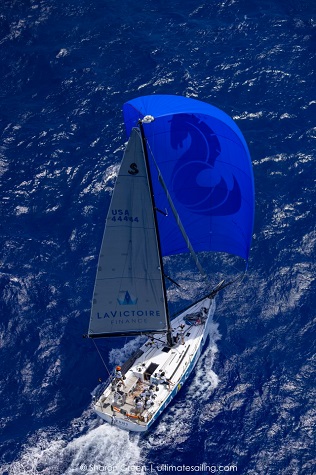
2023 Transpac Race overall winner, flying the spinnaker with an ATN Sleeve.
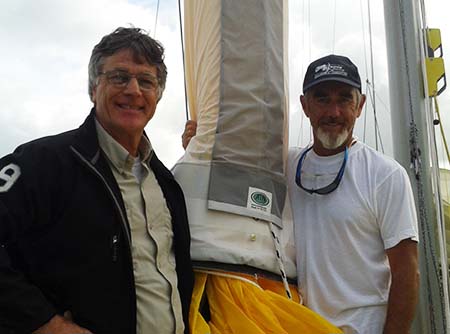
Etienne delivering a Sleeve to Loick Peyron on Happy ahead of the Route du Rhum.
Two Variants: Hard Sleeve and Soft Sleeve
The ATN Spinnaker Sleeve is available in two variants. Both share the same DNA - the unique oval shape, the mesh sock body, the dual-color twist detection, the dual-diameter control line, and the modern Pennant design. They differ in the hoop design and construction.
Hard Spinnaker Sleeve - The Flagship Original
The Hard Spinnaker Sleeve uses an FRP (fiberglass-reinforced plastic) hoop. FRP is a rigid composite that holds its shape under sustained load and will not collapse or jam - the failure mode that disables cheaper alternatives in heavy weather. This is the variant that has been sailing for 40 years and earned the racing pedigree above. It is the right answer for many cruising and racing boats.
Available in hoop sizes #2 and #3 - covering leech lengths from 24 ft to 52 ft.
Soft Spinnaker Sleeve - The Modern Refinement
The Soft Spinnaker Sleeve replaces the FRP bell with a foam-wrapped aluminum frame designed at customer request to make it more compatible with carbon masts. Where it is possible (although difficult) for the FRP to break, the Soft is essentially unbreakable. It is also notably lighter. Basically, it made a very good thing even better.
What you experience differently:
- Rig protection: will not abrade varnish, carbon spars, or painted masts if the sleeve contacts the rig. Optimized for boats with carbon rigs or finished spars.
- Silent deck: no hard hoop-to-deck contact noise. Appreciated on offshore passages (especially night watches) and in marinas.
- Lighter weight: saves several pounds of weight aloft.
Available in hoop sizes #3 thorugh #6 - covering leech lengths from 41 ft to 148 ft.
The ATN Sizing Method
Use the pricing calculator on this page to size your Sleeve. Enter your spinnaker's leech length (decimals OK in feet or meters) plus the type (asymmetric or symmetric) and material weight (light, medium, or heavy). The calculator picks the right hoop size from the ATN range (#2 through #6) using your leech length plus the type and weight adjustments. It then adds the pennant length for that hoop to your leech and rounds down to give you the actual sleeve length we will build for you, and quotes your price.
If you are not sure of any of the inputs, call +1 954-584-2477 or email info@atninc.com with your boat type and sail dimensions. The ATN team will confirm the right hoop and quote your final price.
How to measure your leech
Measure the leech of your spinnaker from head to clew. Enter that number in the calculator - the calculator handles the pennant length and the rounding for you, so the value the calculator returns is the ATN Sleeve length you would actually order.
At the end of the day, the important rule is simple: the sleeve comes close to but does not capture the clew of the sail. If the hoop were to capture the clew, the clew could catch on the hoop opening when you hoist and the sail would not release cleanly. The small section of sail below the sleeve opening will be visible when the sleeve is doused - this looks unexpected the first time but is well-proven best practice across every sleeve size and sail type.
If you do not have the sail yet, use the ISP dimension from your boat's specifications (vertical distance from spinnaker halyard block to deck) as an approximation - this is the maximum hoist of the spinnaker. Most leech lengths are around 92% of the I measurement, but this can vary. We recommend that you measure or confirm the exact leech with your sailmaker before ordering.
For asymmetric spinnakers / cruising chutes: use the leech length of the sail (head to clew). The leech of an asymmetric is shorter than its luff - use the leech, not the luff.
Spinnaker Sleeve Pricing by Hoop Size
| Hoop # | Standard leech range | Hard Sleeve $/ft | Soft Sleeve $/ft |
|---|---|---|---|
| #2 | 24 to 40 ft | $15.75 | Not offered |
| #3 | 41 to 52 ft | $15.75 | $17.33 |
| #4 | 53 to 77 ft | Not offered | $23.04 |
| #5 | 78 to 99 ft | Not offered | $23.54 |
| #6 | 100 to 130 ft | Not offered | $30.80 |
| #7 | 131 to 148 ft | Not offered | $41.80 |
Hoop sizing depends on your spinnaker's weight and overall size, not just leech length. Call +1 954-584-2477 with your spinnaker spec for hoop confirmation if you have any questions. Final hoop is confirmed at quote.
See the Spinnaker Sleeve in Action
Order Your Spinnaker Sleeve
All current Sleeves ship with the updated Generation 3 Pennant design.
Already own an ATN Sleeve? ATN refurbishes and modernizes existing Sleeves in the Pinellas Park shop. Ship yours in for assessment - typical turnaround 2 to 3 weeks. See refurbishment pricing below.
Questions? Sizing help?
Why ATN Spinnaker Sleeve
The ATN Spinnaker Sleeve is the most rugged of the three we tested. It has a lot of design features, which is a sign that the manufacturer has put much thought into product improvement.
- Original design since 1985 - copied but never equaled
- ATN Original hoop design
- Every Vendée Globe winner since 1989 has carried one
- 33,000+ sold in 40+ countries
- You will finally enjoy using your spinnaker safely
Sailors who own a roller-furled headsail often pair the Spinnaker Sleeve with the ATN Genoa Sleeve for headsail UV protection - same fabric heritage, same workshop, same 40-year design discipline.
What Sailors Say About the ATN Spinnaker Sleeve
"The ATN spinnaker socks are marvelous devices. We've used them now for 12 years and love them. Ten years ago we first tried an ATN spinnaker sock on our 67' Sundeer. The result was extraordinary. The ATN system worked well enough for 2 of us to use our spinnaker more often than not on downwind passages. Today my wife Linda and I still use the ATN sock on our 78' Beowulf, and recommend it to all our clients. There simply is not a better way to handle a spinnaker."
Steve Dashew, s/v Beowulf (78 ft). Read on SetSail.com
"I have known Etienne Giroire of ATN for over thirty years. Not only is he a great sailor, he has invented some great products to make sailing more enjoyable and safe. I bought two items from him before my wife and I set sail to do a circumnavigation in our 52 ft ketch Lolita in 1999. The ATN Spinnaker Sleeve made using a Spinnaker easy and fun. I know I would not have even taken the spinnaker along without his sleeve."
Pepper R., circumnavigation 1999 aboard a 52 ft ketch.
"We have been racing for 10 years and buying the ATN sock was a gamechanger. It makes life so much easier and more controlled, especially when dousing: we like to come in on stbd, blow the tack at the mark and snuff it within half a boat length and harden up while we drop the snuffed kite back in the bag. So much quicker and more controlled than bagging it."
Willem, Triple Dutch, Dash 750, Dubai.
Frequently Asked Questions
What's the difference between the ATN Spinnaker Sleeve and cheaper alternatives?
Will it work on an asymmetric spinnaker or cruising chute?
How do I size the Sleeve correctly?
Can one person really use this alone?
Can I retrofit just the modern Pennant, or do I need the full modernization?
The Complete ATN Shorthanded Spinnaker System
Many sailors run the full ATN system: the Spinnaker Sleeve for one-person douse, the ATN Tacker to fly the spinnaker without a pole, and the ATN SnapRatchet ratchet block for mechanical advantage on the sleeve control line. Together, they make single-handed spinnaker handling reliable and repeatable on any passage.
Call +1 954-584-2477 to discuss the right configuration for your boat.
Related ATN Products
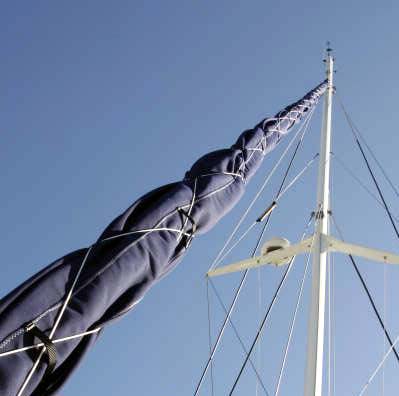
Genoa Sleeve
UV protection for your furled genoa. Available in 10 colors.
View Product
Tacker
Fly a symmetric or asymmetric spinnaker without a pole — shorthanded or solo.
View Product
Gale Sail
Emergency storm sail for roller-furling boats. Sets in minutes.
View Product